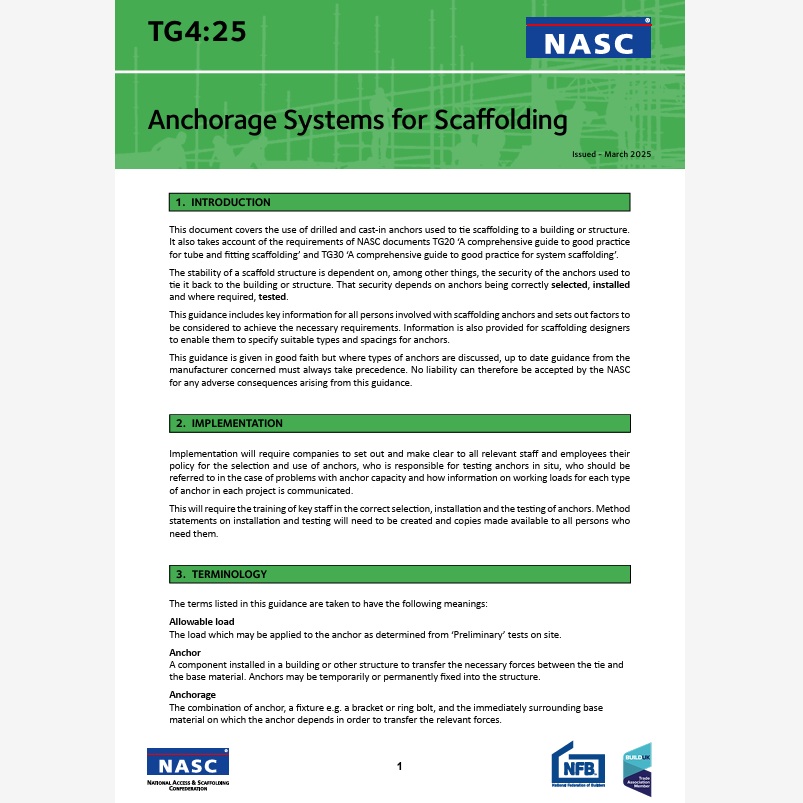
TG04:25 Anchorage Systems for Scaffolding - Digital Download (PDF format)
Brief Information on why anchors are installed and tested:
Ties play a critical role in ensuring the stability of scaffolding structures
Façade access and other scaffolding configurations are typically tall and narrow and therefore rely on secure attachment to a ‘permanent’ building or structure to maintain stability. To achieve this, anchors are often installed into existing masonry or concrete structures to provide an effective means of tying.
Testing requirements
To ensure that anchors are effective and adequate to sustain the loads applied by the scaffolding, tests must be arranged and recorded to confirm:
- the suitability of the fixing within a particular base material (preliminary tests), and
- the quality of the installation (proof tests).
Preliminary testing (not always required)
Typically carried out by contract supervisors before scaffolding is erected, where required. Preliminary testing is carried out only when there is uncertainty about how well a particular type of anchor will perform in a specific base material (for example, brickwork, stone, or timber). These tests are part of the temporary works design process and must be undertaken by a competent person (usually a supervisor). Typically, a small number of anchors are tested under controlled conditions, and the results are reviewed by an engineer or designer. A minimum sample of 5 tests should be carried out to twice the tie load specified on the compliance sheet. Anchors should be not be used after testing.
Proof testing of anchor ties
Typically carried out the lead scaffolding during erection. A sample of anchors must be tested for each scaffolding project. At least 5 % of the anchors (1 in 20) must be tested, chosen at random, with a minimum of 3 anchors tested in every separate and distinct area. The sample anchors must be tested to a load that is 25% greater than the tie duty specified by the TG20 or TG30 compliance sheet or the design.
Competence
The installation and testing of all anchors should only be carried out by trained and competent persons e.g. trained CISRS scaffolders.
Further information
Comprehensive information on ties is detailed in the management guidance document TG4 Anchorage systems for Scaffolding and its User Guide (A6 pocket sized booklet).
TG4 Anchorage Systems for Scaffolding is a 24 page comprehensive technical guidance, aimed at scaffolding contractors, site managers, operatives, and interested parties. It focuses on the correct design, selection, installation, and inspection of anchorage systems to maintain scaffold stability and safety. The guidance covers types of anchors, load considerations, installation procedures, inspection protocols, and operational best practices to prevent failure. By following this guidance scaffolding contractors can ensure compliance with health and safety legislation, and be able to demonstrate that scaffold structures remain secure, stable and safe for continued use.