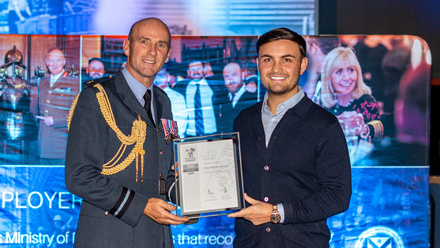
Forty years of doing it right: Chris Sedgeman’s Lifetime Achievement
Chris Sedgeman has spent more than four decades in scaffolding and access, building a career on work other firms would not attempt. This year he was named winner of the Scaffolding Excellence Awards Lifetime Achievement Award 2026.
“I started with very, very little,” he says.
After running Keith Charlesworth’s company for a short period, Charlesworth told him: “I don’t know what you’ve got, but you have got something,” and encouraged him to go out on his own. In July 1996 Chris founded his business with a £5,000 investment and a single guiding principle: if you are going to do a job, you do it right. He credits the backing of his wife and family throughout.
Today, Chris Sedgeman Scaffolding Ltd employs 53 people, carries over £2.75 million in assets, and has grown turnover from under £2 million in 2009 to over £4 million by 2024.
“I always believed I could be very good at what I did if I worked hard enough,” he says. “It wasn’t about becoming a big company; it was about being good at what we do.”
A catalogue of difficulty
“I’ve always enjoyed problem-solving and I’ve never really looked at a scaffolding job and thought we couldn’t find a way of doing it,” Chris says.
At Lloyds Bank Market House in Penzance, a Grade I listed granite building of 1838, what began as a minor brief became a full temporary works operation: a 17-lift scaffold cantilevering over the main bus route without a road closure, carrying a UBIX roof adapted to an octagonal dome and wholly independent of the listed structure.
At St John’s Hall, Penzance, a Grade II civic building occupied throughout, the team devised an in-house 40-metre box gutter and spine beam, crane-lifted as a single assembly to carry dual UBIX roofs over 1,600 square metres. Tested by Storm Ciarán, it held without leakage.
His work has also been tested when the clock is running. In 2014 he directed emergency scaffolding after storms destroyed the Dawlish railway line. When Storm Goretti struck in January 2026 and tore 40 square metres of roof from a fully occupied care home, he coordinated the response, culminating in the engineered reinstatement at Poldhu House and Nursing Home: a wide-span scaffold designed for coastal wind loading, tracked-sheet temporary roofs, asbestos-safe sequencing, a 100-tonne crane operation, and a covered pedestrian tunnel to preserve ambulance access.
More than a decade of research and development has produced innovations now in regular use, among them a modified coupler allowing anchorage without penetrating listed fabric, a council-approved highway barrier system and a child-height handrail for stair towers. Each arose from a client constraint with no existing solution.
Leading from the front
Chris still goes to site and still works alongside new recruits. He was personally present throughout the Storm Goretti response at Poldhu.
His leadership was tested when ROK Plc entered liquidation, leaving the company exposed to over £100,000 of unpaid debt at the most vulnerable point of the year. Chris absorbed it himself rather than pass it to staff or suppliers. The company survived.
Investment in people has been continuous, with 17 SSSTS or CISRS Supervisor cards and 14 Advanced Scaffolder qualifications across the workforce. Chris is a Living Wage Foundation signatory and pays apprentices at qualification rate rather than the legal minimum.
“I’ve always wanted our people to train to the highest level and progress as far as they can,” he says.
The people he has produced
His most enduring contribution is the people. Over 100 scaffolders have been helped to full qualification, several of whom have since established businesses of their own. Scott Nicholas, his first apprentice from 1998, co-founded Raptor Scaffold Design & Consultancy Ltd in 2012 with Chris’s direct support.
“I was extremely proud when my sister, Lynn Way, our Financial Director, became NASC President,” he says. “Lynn has been with me from the very start of the business.”
Chris has maintained NASC membership throughout the company’s trading life, attended parliamentary meetings in support of structured scaffolder training, and taken part in the initiative to bring veterans and service leavers into the trade.
“There’s a real camaraderie between members,” he says. “Being able to talk openly with other companies about jobs, problems and experiences has helped us enormously.”
“Hearing my name called for the Award was quite overwhelming. To think that a small company in Cornwall can achieve what we have, and to look back at what I’ve personally achieved in this industry, made me very proud.”