
INDUSTRY VOICE: Luis McCarthy on Leadership through Crisis
For this week’s feature, JMAC Group’s CEO Luis McCarthy reflects on a crisis that hit his company and how he used it to learn, build and improve. It is testament to his style of leadership that he shares this challenge with the broader industry in the hope that others can learn from his experience.
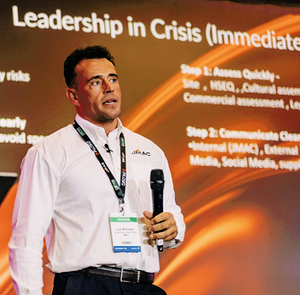
In January 2025, JMAC Group experienced one of the most challenging moments in its history. CEO Luis McCarthy reflects on that period, not to revisit failure, but to share the leadership lessons that come when things go wrong.
Luis took over JMAC at just 23 years old in 2012. At the time, the business turned over £80,000 a year. Founded in 1981 by his grandfather, James McCarthy Senior, JMAC has since grown into a group of specialist companies, operating nationwide across industrial, access, and hire and sales services, with international manufacturing and distribution partners who sell its patented products around the globe.
Luis explained: “The growth of the business has been built on experience, accreditation, and innovation; but January served as a reminder that no business, regardless of scale or capability, is immune to crisis”.
On 24 January 2025, a 42-metre temporary roof canopy collapsed at the Carlisle Sands Centre during Storm Éowyn. Thankfully, no one was injured, but the incident presented immediate risks to people, reputation, and performance. “Leadership in moments like this comes down to five fundamentals. First, assess quickly. Facts must be gathered without assumption, and the situation viewed holistically; from site safety and engineering, to commercial, legal, cultural, and client considerations.
“Second, communicate clearly. In an age of instant media coverage, consistent and factual communication is critical, both externally and internally. Avoiding speculation protects trust.
“Third, mobilise teams. JMAC immediately established dedicated site, investigation, engineering, and client liaison teams, each with clear responsibility.
“Fourth, act decisively. Immediate controls were implemented, progress monitored, and decisions taken without delay.
“Finally, review and adapt. Crisis management is not linear; it requires constant reassessment and the willingness to pivot. A visible site presence also proved vital. Being present built confidence with the client and reinforced accountability.
“The experience highlighted important learnings. Commercially, it reinforced the need for strong governance, contract risk categorisation, and assessment of liabilities - safeguards that proved to be invaluable.
“From a design perspective, the event highlighted the need for industry-wide improvement. This included clearer client design briefs aligned to BS5975, improved designer training and proven competence, recognising scaffolding design as a specialist discipline, alongside updated wind loading guidance. I also called for clearer direction within BS5975 for both main contractors and subcontractors, and for the inclusion of formal wind management planning within TG9 to better reflect the realities of temporary roof and suspended access works.
“Crucially, JMAC and the client chose collaboration over conflict; and support from consultants, engineers, insurers, suppliers, and even competitors, underlined the strength of the scaffolding community when it matters most.
“JMAC’s belief from this challenging situation is that every failing is an opportunity to build strength. The experience has sharpened JMAC’s systems, leadership, and resolve - reinforcing that true leadership is not defined by avoiding challenges, but by how you respond when they arise.”