Project in focus: Hungerford Bridge
Contractor: Alltask
Project: Hungerford Bridge
Client: VolkerFitzpatrick Ltd
Hanging scaffolds, also known as cantilevered or complex overhead scaffolds, which are used when traditional ground-supported scaffolding is impractical or impossible, present scaffolding contractors with unique technical and operational challenges. Always visually impressive, a huge amount of work goes into making them successful and safe. Here, we look at how Alltask used such a structure on the Hungerford Bridge project. And we also consider the implications for last year’s update to the guidance on working near or over water.
Before starting work on the iconic Hungerford Bridge, Alltask spent three years working on design and planning alongside partners Prime Scaffold and Structural Designs Limited. This 161-year-old railway bridge across the Thames, a vital connection to Charing Cross Station, is undergoing essential restoration to preserve its structure and extend its service life.
Scope Overview
Hungerford Bridge is a six-span structure that carries five electrified railway lines across the River Thames, right in the heart of London. The bridge comprises four main steel lattice girders (designated A, B, D and E), three sub-decks, and supporting elements including cross girders, rail bearers and bracing. The red brick abutments and piers provide a striking contrast to the steel superstructure. While most of the intermediate supports are steel, the Surrey Pier between spans 4 and 5 — along with the Middlesex Pier — is built from red brick and forms part of structure 7C.
On approach, the bridge connects to a brick viaduct from the south and three metal deck spans at the northern ‘Fan End’, framed on either side by the Golden Jubilee footbridges. The project includes comprehensive steel strengthening, abrasive blasting, and repainting of the main longitudinal girders that span the River Thames. The restoration also involves steelwork cleaning and repainting, removal of fractured decorative cast-iron collars, brickwork and cast-iron column repairs, and the replacement of failed truss pin end caps with new aluminium designs.
Access is also being provided to allow inspection and maintenance of connection pins attaching the cross girders to the main trusses, and brickwork repairs will also take place. To support these works, Alltask is delivering the access solutions — including the design and erection of scaffolding across the structure. The scaffolding design has been developed in collaboration with Prime Scaffold and Structural Designs Limited to ensure safe, efficient delivery across all phases of the restoration.
Access Design and Engineering Collaboration
The design scope for the scaffolding was to provide access to all bridge girders across each of the six spans. With the River Thames below and active Network Rail lines above, the structure presented a complex range of hazards - requiring safe clearances beneath, beside and above the bridge at all times. Design constraints were shaped by strict Port of London Authority requirements, which required vertical clearance for uninterrupted river traffic. Simultaneously, the running Network Rail lines demanded minimum vertical and lateral clearance to ensure the continuous and safe passage of live trains.
Initial design proposals were developed by Prime Scaffold and Structural Designs Limited (PSD) and further refined in collaboration with the Southern Renewals Enterprise (SRE), Alltask and Network Rail. The scaffold’s structural principles were based on cantilever and bridge beam arrangements to support suspended working platforms. External access was achieved through cantilever drop scaffolds fixed to each outer girder, maintaining river and rail clearances while enabling safe working conditions.
For access to the underside of the bridge, continuous bridge beams between cross girders were used to suspend platforms below the longitudinal steelwork. To safeguard both railway and marine operations, regular interface reviews were conducted with Network Rail’s signalling and track teams to ensure no disruption to either train operators from Charing Cross or to river traffic along the Thames.
Working Over Water
Due to the unique characteristics of each span, scaffold phasing required individual designs. PSD completed over 30 detailed drawings, calculations and clearance analyses to map out every span’s interface requirements and plan works in advance. This rigorous approach enabled efficient execution and forward planning for subsequent restoration phases. The design team from PSD worked closely with Alltask throughout, ensuring smooth progression from initial concept through to final construction status (AFC), supported by regular design review meetings that kept the project on schedule and within budget.
Progress and the future
Each section of the bridge presented its own unique challenges and required careful coordination and expertise. Images capture the scale and precision of the work. This is down to dedicated teams at Alltask, design partners at Prime Scaffold and Structural Designs Limited, and client VolkerFitzpatrick Ltd, supported by Livett’s and the Southern Renewals Enterprise — a collaborative delivery model led by Network Rail to streamline major project delivery across the southern region. The project remains on track and is expected to be completed in late 2027.
SG42:25 Working over water
NASC’s Safety Guidance document SG42:25 provides safety measures for scaffolding work carried out over or near water. Employers should conduct a comprehensive risk assessment for this kind of work, considering the hazards identified and evaluated during the assessment, to develop a safe system of work. Employers are also responsible for providing their workers with the necessary safety information, instruction, training, and supervision, as well as intensifying safety measures on the use of lifting appliances, mobile plant, lifejackets and buoyancy aids. Effective rescue and emergency arrangements should be established for work over / near water to safeguard workers in an emergency situation.
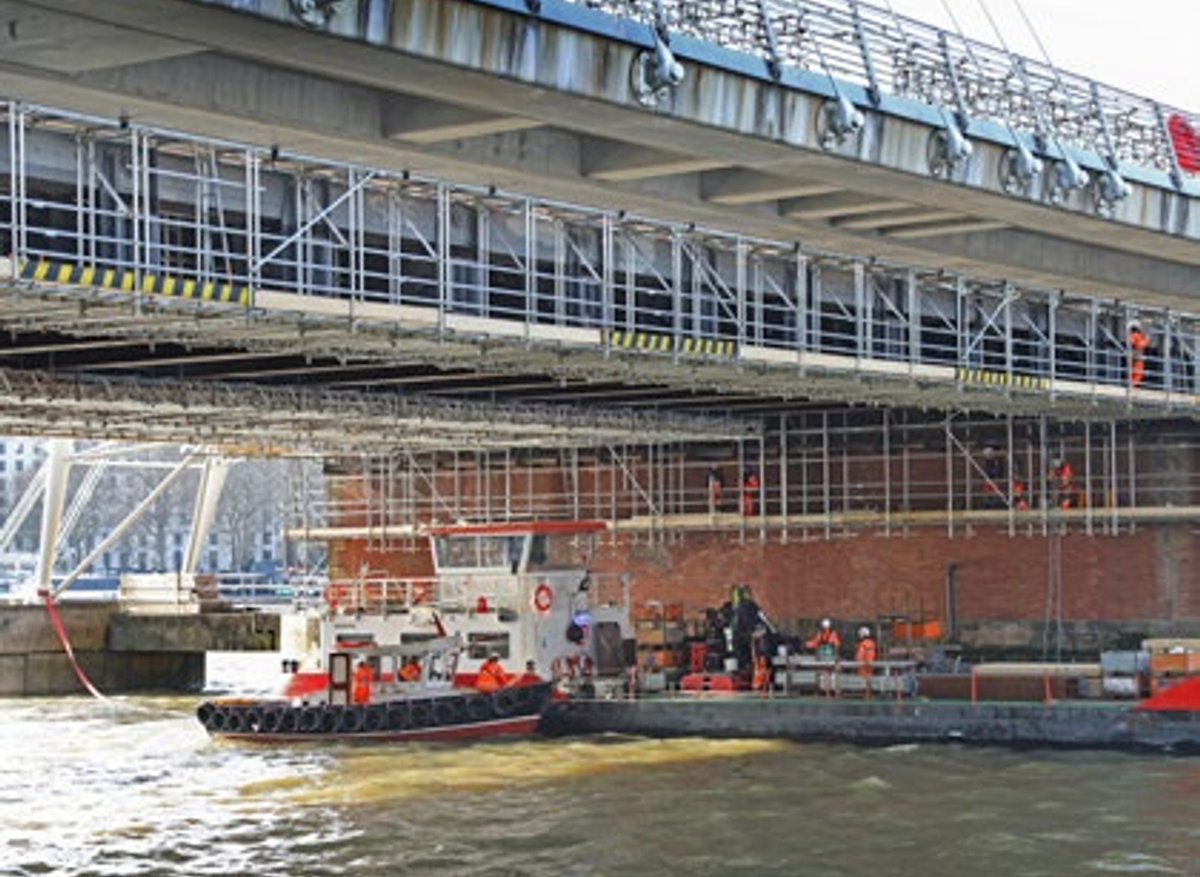
Hungerford Bridge
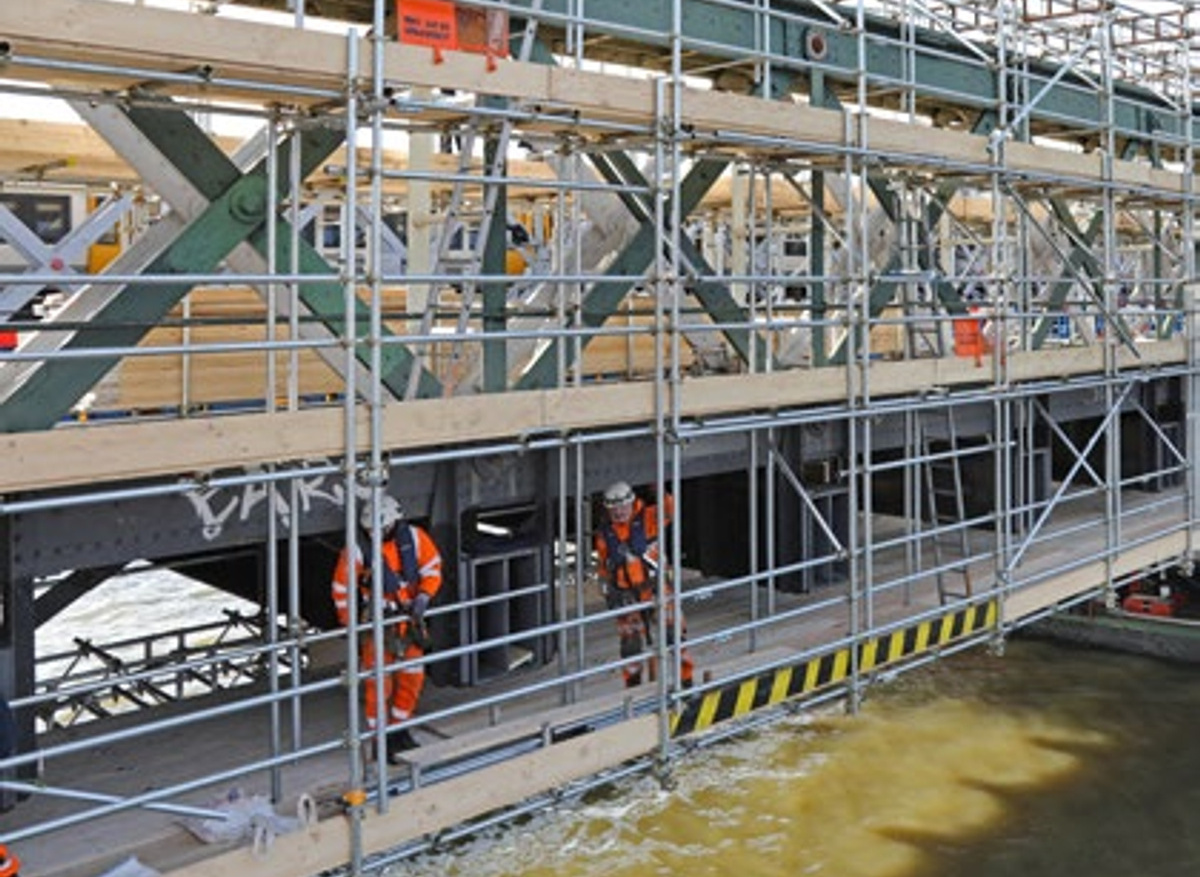
Work in progress
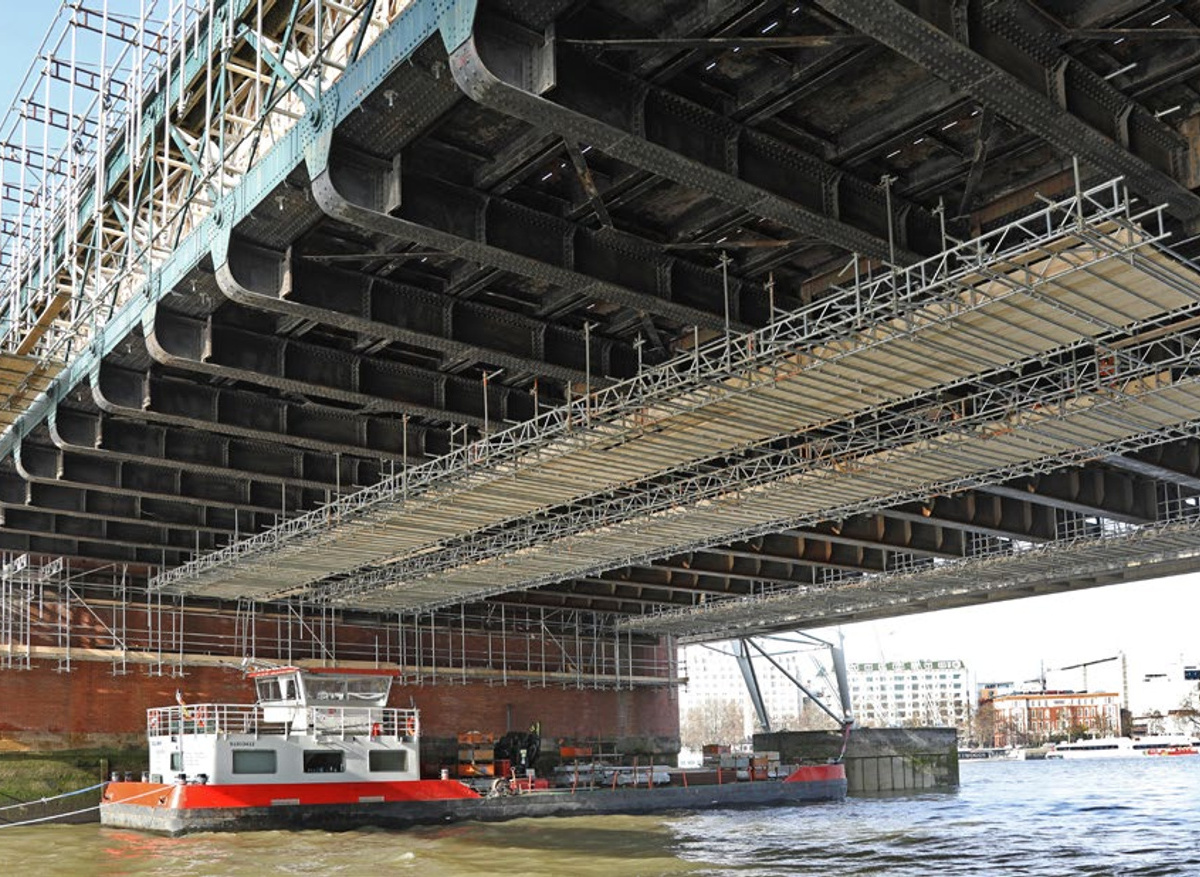
A closer look underneath