Keeping the lights on: the scaffolding holding up the UK's energy infrastructure
There is a particular kind of scaffolding job where the design case is not the wind you expect, but the wind that arrives once every ten thousand years. Heysham 2 is one of them.
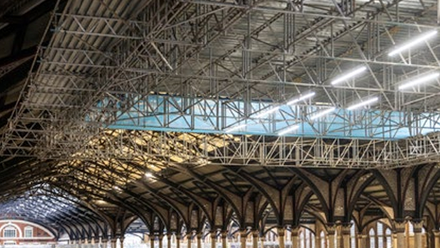
Altrad has been supporting EDF's nuclear fleet for years, and its work on the Chargehall Roof Remediation Project at Heysham 2 is among the most technically demanding scaffolding and access packages currently live in the UK. The wider project is valued at £7.5 million, of which £1.94 million covers Altrad's scaffolding and access services. The objective is straightforward to state and considerably harder to deliver: replace a 7,000m² roof and extend the station's operational life by at least ten years, with further service beyond that during defuelling and decommissioning.
The structure
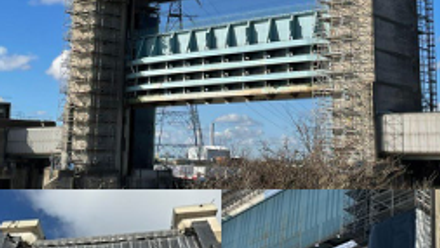
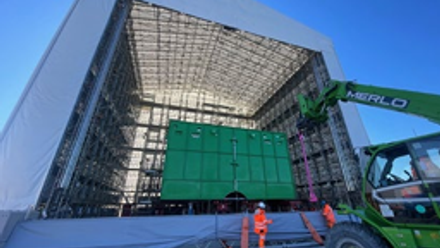
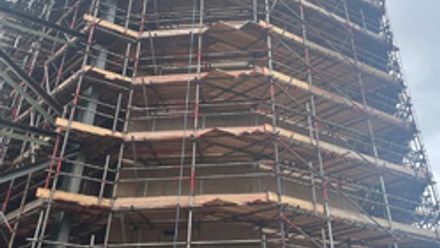
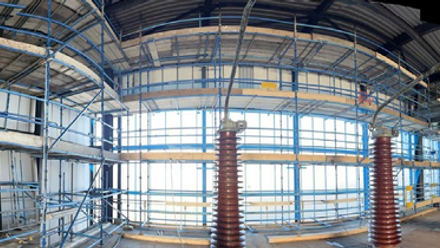
The scale is difficult to picture from the numbers alone. The scaffold runs more than 70m in length, 14m wide, and rises to 74.5m at its highest point. It stands 38 lifts high, with 33 of those boarded out for access and inspection. Holding it together is over 350 tonnes of HAKI Universal System scaffold.
Built into the structure is a hoist support arrangement carrying both materials and personnel to roof level at 74.5m; a considerable engineering exercise in its own right on a live nuclear site.
The most demanding element sits below. More than 220 DESSA 1280mm-deep aluminium beams create a 31.5m clear span supporting eleven lifts of scaffolding above a radiologically controlled building whose roof carries no load at all. A further 150-plus 750mm-deep aluminium beams support up to twelve lifts elsewhere across the structure, bridging obstructions and keeping access routes open beneath.
Designing for the once-in-ten-thousand-years event
Nuclear work brings design criteria that most scaffolding contractors never encounter. The structure had to be engineered to withstand seismic activity and a 10,000-year wind event, with leg loadings reaching 27 tonnes and spans of up to 31.5m.
Those loadings, combined with the hoist support and seismic dynamic forces, drive an anchoring requirement well beyond anything on a conventional project. Altrad's solution combines DESSA shear plates fixed with Hilti anchor bolts, Band & Plate couplers with Hilti anchor bolts, and Gravlock couplers fixed directly to steelwork through holes cored in the cladding.
Where suitable tie points simply did not exist, the team created them. A full independent scaffold was erected inside the building by rope access trained scaffolders purely to provide anchorage for the external structure, a scaffold built to hold up another scaffold.
Tested by weather, not by modelling
Design assumptions are one thing. The structure has since stood through Storm Éowyn and a succession of other named storms without damage, and it will remain in place for a further year.
That is the part worth dwelling on. A temporary structure that has already outlasted several of the most severe weather events of recent years, on an exposed coastal site, while allowing a live power station to continue operating and a 7,000m² roof to be replaced above a radiologically controlled area.
Why it matters beyond Heysham
Projects like this are a reminder of where scaffolding actually sits in the national picture. The UK's energy infrastructure does not maintain itself, and the work of extending the life of an ageing nuclear fleet depends on access solutions that can be designed, engineered, justified and signed off against criteria most industries never have to consider.
It is also a demonstration of the engineering depth now sitting within the scaffolding and access sector; bespoke design, complex load transfer, rope access disciplines and a level of technical assurance that would not look out of place in any other engineering profession.
The lights stay on. Someone has to build the access that keeps them on.